Ditty Dokter
Tapestry Weaver
Upcoming Exhibitions
Cambridge Open Studios 11-12, 18 -19 July 2026
Riverside Arts
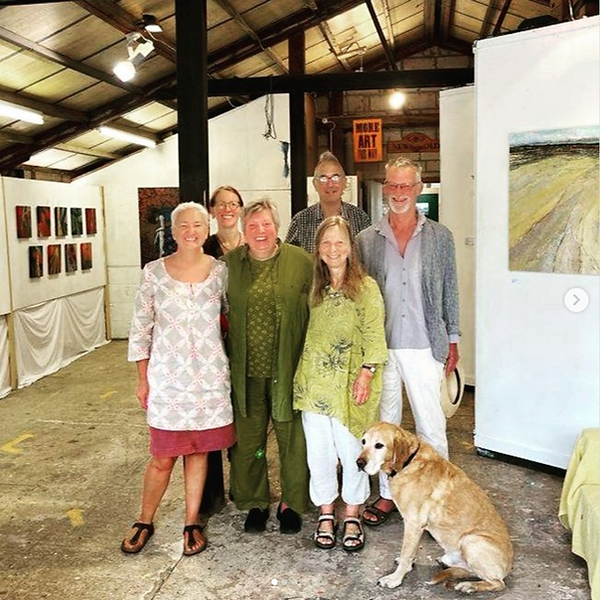
Annually I take part in Cambridge Open studios with the Riverside artists in Little Ouse
Guide page 111b
"The best exhibition we've seen this year at Cambridge Open Studios" is a wonderful comment left by one of our visitors last year!
Riverside Arts is a group of artist makers exhibiting annually as part of Cambridge Open Studios (www.camopenstudios.org) at
Rick Forward's New from Old furniture workshop in Little Ouse.
Visitors to our Open Studio on weekends 11/12th and 18/19th July will discover a wealth of small scale furniture and sculpture,
paintings, sketchbooks and greeting cards, many of which explore place, both Fenland and abroad, Tapestry weavings of the sky, land and water scapes in the Fens, Netherlands and further afield and letterpress prints on a range of themes
Haddenham Arts Centre 5 September to 1 November 2026
EXHIBITION: Jeni Cairns Metal Sculptures
& Ditty Dokter Woven Tapestries
-
Saturday, September 5, 2026 10:00 AM to Sunday, November 1, 2026 4:00 PM
-
Haddenham Arts Centre 20 High Street Haddenham, cb6 3xa England (map)
Jeni Cairns is an award winning artist and garden designer living in rural Cambridgeshire
Jeni has always been inspired by the natural landscape that has surrounded her most of
her life. A childhood spent exploring the farmland, lanes and areas reclaimed by nature
have left a lasting impression.
“I find the medium of metal a perfect way to express my ideas on nature, there’s a delicacy
yet enduring strength and resilience in nature as it always (I hope) finds a way to survive and flourish.”
Jeni studied general art and design at Isle of Ely college and Fine Art at Derby university.
Ditty Dokter ‘s landscape based tapestries often relate to her Dutch and east Anglian homes;
a detail, an element, sometimes a more figurative impression. She uses a range of yarns including linen, cotton, wool, silk, fleece and found objects. Guided by colour and shape, the natural materials aim to evoke the qualities of home and (not) being at home. She initially trained with Eta Ingram, subsequently did the 2 years Westdean college training with Philip Sanderson, followed by specialist courses with master weavers such as Louise Martin. She prefers a more open improvisational weaving style. Some of her work has been completed and exhibited in interaction with performance / film material rooted in migrant experience, . Her recent work has focussed on connections through forests and fungi.

Previous Exhibitions
Fenlands Exhibition Courtyard Gallery.Hertford 2025


St Albans Museum and Gallery Exhibition 2024

Red Engine House Ely - Cambridge Open Studio Anniversary Exhibition 2024

Previous Riverside Artist Cambridge Open Studio Exhibitions since July 2018
Previous performances
Come or Go (2017) Site specific performance. Charmouth, September 2017
‘Come or Go’ concerned the choice whether to stay or go post the Brexit vote of 2016. That referendum started a period of limbo for EU citizens in the UK (Remigi and Martin 2017). The referendum split the UK into those who voted to remain against those voting to leave, with a small minority on the leave side. I wanted to share the impact of the hostile environment to immigration on my sense of belonging. I chose to create a public performance in an area with a strong ‘leave’ vote. I wove a willow boat and the beach was the public performance site location. The flux between land and sea, the constantly shifting landscape reflected my questions about belonging and welcome. I have restricted mobility; the surface of pebbles made walking hazardous and I needed helpers to facilitate my entry in and exit from the sea. This reflected my own ambivalence whether I had steady ground under my feet in the face of Brexit, was I assisted to leave or to remain? The timing of the promenade performance was at the change of the tide where the sea starts to return and the land disappears.
I wrote in my log “It is a very blustery September day when I meet with my audience on Charmouth beach. Using my sticks I draw COME on one and Go on the other side of the outlet pipe on the beach. I am aware that my ‘known’ audience has gathered underneath the quay, whilst strangers witness me from above or walk past me, mostly giving me a wide birth. I walk with my sticks over the outlet pipe towards the lower audience group and invite them to join me to walk the words as a path, first Come than Go. My woven boat awaits at Go and I say goodbye to the group by giving a sprig of flowers to each person in the circle. I pick up the boat, lift it on my shoulder and walk across the beach to where the river flows across it to the sea. The audience has walked with me and I apologetically explain that I know the boat is probably not seaworthy but that ‘if you have to go, you have to go’. The audience moves me by spontaneously weaving the flowers I gave them into the willow boat. My helper supports me in trying to launch the boat, then in the sea itself. At the edge of the beach I leave my stick and I swim out alone with the boat. It proves not seaworthy in the waves and capsizes despite my best efforts to keep it (and me) afloat. Floating on its side the boat returns, as do I.
I sing ‘Ik zou wel eens willen weten/ I really would like to know ‘ (de Corte, 1955) each verse in Dutch and English at different places during the promenade (at Come by the sea, at the launch of the boat in the river and on my final return to the beach). The final verse identifies with the corroding cliffs at Charmouth, not knowing how long they will live and belong or when they will disappear”.
The slide show at https://youtu.be/e0k-Kdm8Bxg was photographed and collated by Stephen Hopkins. Further discussion of the performance was published in Ditty Dokter (2022) Arts based research and autobiographical performance. In M. Rova and C. Frizell (eds) Research and practice that brings us home. The body as a catalyst for change. London: Routledge
Fluid Borders (2021) Site specific performance. Wootton Fitzpaine, Dorset. September 2021
The performance was titled Fluid borders and was devised during lockdown. Its initial theme was around ‘staying’ and was developed in the context of bereavement, the pandemic impact, the implementation of Brexit and applying for settled status and citizenship. Themes emerged around fluid and rigid borders in relation to migrant identity. The site-specific performance took place 8 months after the implementation of Britain leaving the EU. Lockdown, Brexit, the loss of my mother and (temporary) loss of my daughter through locked borders were given form. Migration impacts differently and needs to be revisited at each major life transition. There is an assumption that migration will occur in early to midlife and is a one-off event. More recent literature is starting to explore the impact on later life.
The first devising period occurred during lockdown. As a first step I decided to make a film. This connected my mother as a skater and myself as a swimmer through my mother’s old Dutch skates and my swimming in a local river at Skaters’ Meadow; connecting my two homes of east Anglia and the eastern Netherlands. The focus was on the props and landscape, representing time and place. Using a head camera I aimed to let the audience share my swimming experience. During preparations[1] one colleague commented “but you swim in the rivers that connect you”.
This comment became the leitmotif for my final inquiry. I composed new lyrics about fluid borders to a Dutch water carrier song (de Groot, 1968), translation provided to the audience via the performance programme. When meeting in person for the final devising phase, I re-enacted some of the lockdown experiences; being confined, escaping through swimming, cut off from loved ones, imagining the rivers as connecting systems to still experience ‘being with’. In the performance the skating and swimming in the film is accompanied under the screen by my feet moving frustratedly on a small rug, which used to belong to my mother. I sing live whilst the film shows my hands in breaststroke through the river. I welcome the audience by showing them the river systems and North Sea connecting my two homes via a nautical chart wrapped around my body.
I wanted to include audience participation in the process of journeying. The performance took shape in three consecutive stages; starting as a ‘proscemium arch’ type performance, but crossing the actor-audience boundary by enactment before and behind a screen and as story- teller directly addressing the audience. The audience was then invited to come through the screen and join the performer on a walk to the river. This journey involved a ‘border crossing’ where the audience was divided into two groups which were led to both sides of the river, where the performer embodied the sense of travelling back and forwards by weaving a web across the stream, handing the thread to audience members who came to represent loved ones on both sides of the water.
The performance was filmed by Stephen Hopkins, and edited by Jean Francois Jacques. The edited video can be seen on youtube at https://youtu.be/o49MhoBEYp8
Further discussion of the performance is in D. Dokter (2024) Echoes across the generations; the relationship between mover and witness in audience responses[2] [3] to an autobiographical performance. In M. Rova and C. Frizell (eds) Practice research through creative bodies. London: Routledge
Mycelial connections over time. Wootton Fitzpaine, Dorset, September 2025
In this, the final triptych of the performances, I explored the impact of returning to the Netherlands for temporary residence to ensure that all family members could obtain dual citizenship in both the UK and the Netherlands. We lived in the forest with which I had grown up. Many old family photos of previous generations showed that forest as background, not only as the location of family holidays, but also because several generations were treated for tuberculosis in the forest sanatorium Sonnevanck. I was the last of the generations to be treated there as a child.
On deciding that, having acquired the necessary citizenship papers, we would return to the UK as permanent residence (as by then both children were back in the UK too) I decided to focus in this final performance on connections rather than separations (as in the previous two). Connections were embodied by the metaphor of mycelium feeding trees and fungi as fruiting visible bodies. I decided to create a film made in situ. I moved in different parts of the Dutch forest, to commemorate living and dying and used that, together with family photos and film clips over the generations, to create the film that was shown during the performance. The audience was invited to explore a mycelial indoor performance environment from which hung old family photos. The film was shown and two performers of different generations interacted with the environment and the film to portray the passing on of the thread of life across the generations.
David Tatem filmed on location in the Netherlands and the final compellation was edited by David Tatem and Ditty Dokter prior to the performance in September 2025. The film can be seen on youtube at https://youtu.be/Po3wT6JGrWc